What are peptides? A plain definition
A peptide is a short chain of amino acids joined end to end by peptide bonds. Chains of roughly two to fifty residues are called peptides; longer chains that fold into a stable three-dimensional structure are called proteins.
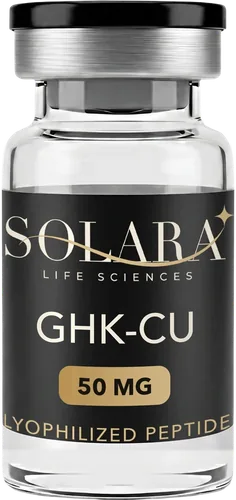
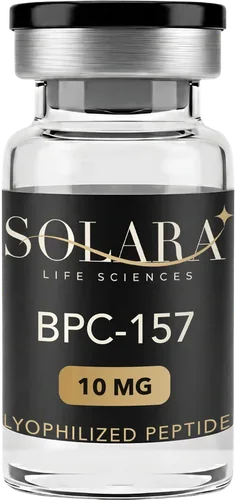
The word covers an enormous range of molecules. A dipeptide is two amino acids. GHK, the tripeptide in GHK-Cu, is three. BPC-157 is fifteen. Tesamorelin is forty-four, close to the point where chemists stop saying peptide and start saying protein. All of them are built from the same twenty standard amino acids, sometimes with modified or non-standard residues, and all are linked by the same kind of bond.
The peptide bond
Every amino acid carries an amino group at one end and a carboxylic acid group at the other. When the carboxyl of one residue condenses with the amino group of the next, a molecule of water is lost and an amide bond forms between them. Chemists call that amide a peptide bond. Repeating it builds a backbone with a free amino group at one end (the N-terminus) and a free carboxyl at the other (the C-terminus).
A sequence is written from the N-terminus to the C-terminus, in three-letter or one-letter code. GHK is Gly-His-Lys, or simply GHK. The molecular mass of a peptide is the sum of its residue masses plus one water, which is why a sequence alone is enough to predict the mass an analytical laboratory should find.
Natural and synthetic
Peptides occur throughout biology, as fragments cut from larger proteins and as signalling molecules in their own right; many hormones found in animals are peptides. A synthetic peptide reproduces a chosen sequence by chemical synthesis rather than by isolating it from a living source. If the sequence, the modifications and the stereochemistry match, the synthetic molecule is the same molecule. That is a statement about structure. It says nothing about what the molecule does, and no page on this site does either.
How a peptide is described
- Sequence: the order of residues from N- to C-terminus, with any modifications (an acetyl group at the N-terminus, an amide at the C-terminus, a metal complexed to the chain).
- Length and mass: the residue count, and the molecular mass the sequence predicts.
- Salt form: synthetic peptides are usually supplied as acetate or trifluoroacetate salts, and the salt is part of the powder's mass.
- Purity: the fraction of the peptide material that is the target sequence, usually measured by reverse-phase HPLC at 214 nm.
- Net peptide content: how much of a weighed powder is peptide at all, as opposed to counter-ion and water.
Two of those items are often confused. Purity versus net peptide content explains why a figure of 99% by HPLC does not mean 99% peptide by weight. How research peptides are named explains the codes, fragment ranges and suffixes that carry the rest of the specification.
What a research peptide is on this site
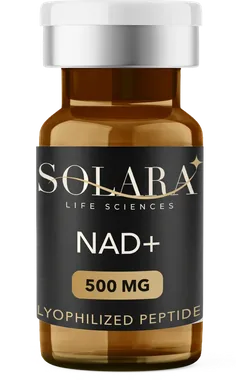
Every compound in the Solara catalogue is supplied as a lyophilized powder, labelled with its common name, the total quantity in milligrams, the form, an expiry date, and the words for research use only. Reading a Solara label walks through each line, and What lyophilized means covers the form.
What this does not establish
- Membership of the chemical class says nothing about what a molecule does; this article describes structure only.
- A synthetic peptide matching a natural sequence is a statement about identity of structure, not about any property of the material.
- The size boundary between peptide and protein is a convention, not a property; sources draw it anywhere from forty to one hundred residues.
Questions
Is a peptide the same as a protein?
What is the difference between a peptide and an amino acid?
Are all the compounds in the Solara catalogue peptides?
References
- IUPAC-IUB Joint Commission on Biochemical Nomenclature. Nomenclature and symbolism for amino acids and peptides. Recommendations 1983. Eur J Biochem, 1984.
- Merrifield B. Solid phase synthesis. Science, 1986.
Every compound on this site is supplied as a lyophilized powder for laboratory research use only. Nothing in this article describes an effect on a person or is a claim about any product.