How research peptides are named
A research peptide's name is a specification in shorthand. Code numbers, fragment ranges, suffixes such as "No DAC" or "LR3", and prefixes such as "Ac-" each state something about the molecule, and two products with similar names can be different molecules.
A name on a vial is only as precise as the convention behind it. Four conventions cover most names: originator codes, fragment ranges, modifier markers and nonproprietary names. The IUPAC-IUB recommendations set out the written symbols for amino acids and peptides, including the direction in which a sequence is read.
Code names do not state structure
BPC-157, CJC-1295, PT-141, AOD-9604, SS-31 and SLU-PP-332 are originator codes. Some prefixes name a source: PT for Palatin Technologies, SS for Szeto and Schiller, SLU for Saint Louis University. Others state nothing about structure. The number is a serial, not a residue count. BPC-157 has fifteen amino acids, and SLU-PP-332 is a small molecule with no residues at all. A code has to be resolved to a sequence or structure before it identifies anything.
Fragment notation points to a parent
Fragment names refer to a longer parent sequence. The number is either a length or a range of positions counted from the N-terminus. Kisspeptin-10 is the 10-residue C-terminal fragment of kisspeptin-54. AOD-9604 corresponds to residues 176 to 191 of human growth hormone, with tyrosine in place of the phenylalanine at position 176 (written Tyr-hGH(177-191)). Semax is the ACTH(4-7) sequence, Met-Glu-His-Phe, followed by Pro-Gly-Pro, and is often described as an analogue of ACTH(4-10). The parent sequence has to be looked up to know the actual order of residues.
Markers that change the molecule
Short markers in a name usually stand for a chemical change, and a chemical change makes a different molecule.
| Marker | What it states |
|---|---|
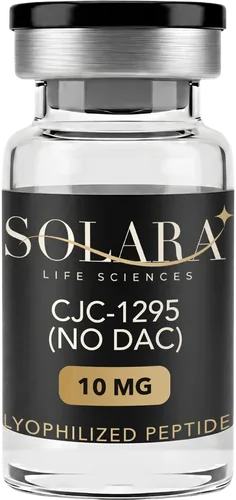
| No DAC (CJC-1295) | Without the Drug Affinity Complex, a lysine carrying a maleimidopropionyl group, a thiol-reactive chemical handle. Mass differs: about 3647 Da with DAC, 3368 Da without. |
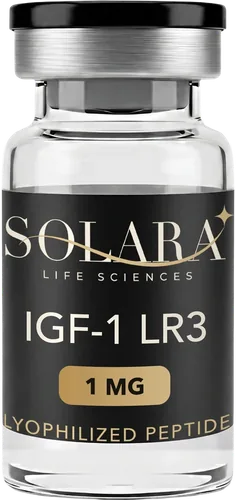
| LR3 (IGF-1 LR3) | Long R3: a 13-residue N-terminal extension, and arginine substituted at position 3 of IGF-1. |
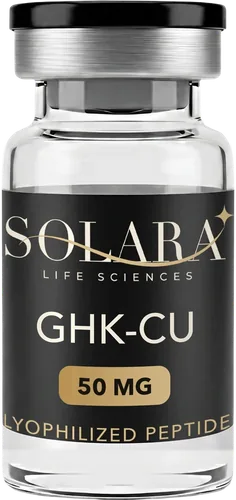
| Cu (GHK-Cu) | The copper(II) complex of the tripeptide glycyl-L-histidyl-L-lysine. |
| Ac- | Acetylation of the N-terminus. |
| -NH2 | Amidation of the C-terminus, in place of a free carboxylic acid. |
| Acetate | The salt form: the counter-ion supplied with the peptide. The sequence is unchanged, but the peptide share of a weighed quantity is not. |
An acetyl group adds about 42 Da. Most markers mark a different compound; a salt marker marks a different material of the same compound.
Nonproprietary names
Bremelanotide (PT-141) and elamipretide (SS-31) are International Nonproprietary Names, assigned by the World Health Organization so that one substance carries one globally recognised name. A name on a label, code or INN, is not evidence of identity; identity is established by analysis such as mass spectrometry, and a name says nothing about who supplied a given vial or under what grade.
What a vial label carries
Solara's labels carry the common name, the quantity in milligrams, the form, an expiry date, and the words "for research use only". The full amino acid sequence and the salt form are not printed on the label, and no lot documentation stating them is published. A Solara label is therefore a name and a quantity; a looked-up sequence is the literature sequence, not a measurement of the vial's contents.
What this does not establish
- A shared code or name across suppliers does not establish that the molecules are identical.
- An INN existing for a substance says nothing about the grade or status of a research vial.
- Nothing here describes the function of any compound; the article covers naming only.
Questions
What does No DAC mean on CJC-1295?
Why do some peptides have a number in the name?
What does LR3 stand for?
References
- IUPAC-IUB Joint Commission on Biochemical Nomenclature. Nomenclature and symbolism for amino acids and peptides. Recommendations 1983. Eur J Biochem, 1984.
- Low TL et al. Complete amino acid sequence of bovine thymosin beta 4: a thymic hormone that induces terminal deoxynucleotidyl transferase activity in thymocyte populations. Proc Natl Acad Sci U S A, 1981.
- Guidance on the use of International Nonproprietary Names (INNs) for pharmaceutical substances. World Health Organization, 2017.
Every compound on this site is supplied as a lyophilized powder for laboratory research use only. Nothing in this article describes an effect on a person or is a claim about any product.