What lyophilized means
Lyophilized means freeze-dried: water is removed from a frozen solution by sublimation under vacuum, leaving a dry, porous solid called the cake. A peptide held as a dry cake generally degrades more slowly than the same peptide in solution.
Lyophilization is carried out in a vacuum chamber with temperature-controlled shelves. It is the standard way to supply peptides that keep poorly in water. The water leaves as vapour and never as liquid, so the solid keeps the porous structure of the frozen solution.
The three stages of lyophilization
- Freezing: the solution is cooled until its water is ice and the peptide and any other solids are concentrated between the crystals.
- Primary drying: under vacuum, with the product held below its collapse temperature, the ice sublimes straight to vapour. This removes the bulk of the water and is usually the longest stage.
- Secondary drying: at a higher temperature, water still bound to the solid desorbs. This stage sets the final residual moisture.
Why peptides are supplied dry
Hydrolysis and deamidation consume water, and oxidation and aggregation run faster where molecules are mobile, so all four are fastest in solution. A dry solid slows these routes without stopping them. It is also light and compact to ship.
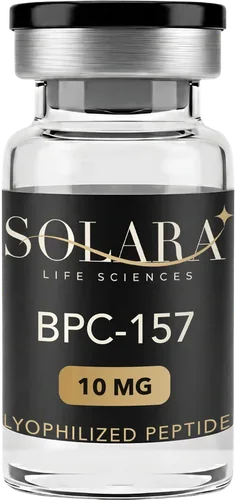
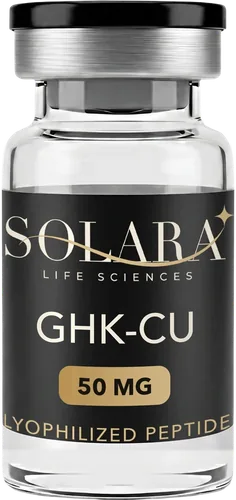
Catalogue items such as BPC-157 are lyophilized in this sense. Each Solara vial is a lyophilized powder, labelled with the compound name, the quantity in milligrams, the form, an expiry date and "for research use only". Site guidance is to store the powder at −20 °C, protected from light. Solara publishes no stability data, so the slower chemistry of the dry form is a general property, not a measured figure for any vial.
What a cake looks like
A well-formed cake is a uniform, porous solid, white to off-white for most peptides (a copper complex such as GHK-Cu is blue), that holds the shape the frozen solution had in the vial. The pores mark where the ice sat. The amount of solid changes the look: a small fill can appear as a thin film or a few flakes rather than a cake.
What residual moisture means
Residual moisture is the water left in the cake after drying, expressed as a percentage of mass (w/w). It is commonly targeted at low single-digit percent w/w and commonly measured by Karl Fischer titration, which reacts with water directly. The target depends on the formulation, and a measured figure belongs to a lot, not to a compound.
A limit of Solara's own position: Solara does not publish residual-moisture figures per lot, so no moisture value is stated for any vial in the catalogue.
What this does not establish
- A well-formed cake does not by itself show the purity or identity of the peptide.
- Freeze-drying is a drying step, not a sterilization step.
- Appearance alone does not give a moisture content; only a measurement such as Karl Fischer titration does.
Questions
Is a lyophilized peptide the same as a powder made by evaporation?
Why does a lyophilized cake sometimes look shrunken?
Does freeze-drying remove all water?
References
- Tang X et al. Design of freeze-drying processes for pharmaceuticals: practical advice. Pharmaceutical Research, 2004.
- Carpenter JF et al. Rational design of stable lyophilized protein formulations: some practical advice. Pharmaceutical Research, 1997.
- Chang LL et al. Effect of sorbitol and residual moisture on the stability of lyophilized antibodies: Implications for the mechanism of protein stabilization in the solid state. Journal of Pharmaceutical Sciences, 2005.
- Patel SM et al. Lyophilized Drug Product Cake Appearance: What Is Acceptable?. Journal of Pharmaceutical Sciences, 2017.
Every compound on this site is supplied as a lyophilized powder for laboratory research use only. Nothing in this article describes an effect on a person or is a claim about any product.