Types of peptides: by length, shape and modification
The main types of peptides are classed by length (dipeptides, tripeptides, oligopeptides and polypeptides), by shape (linear or cyclic) and by chemical modification (acetylated, amidated, lipidated or metal-complexed). Each class describes structure and says nothing about function.
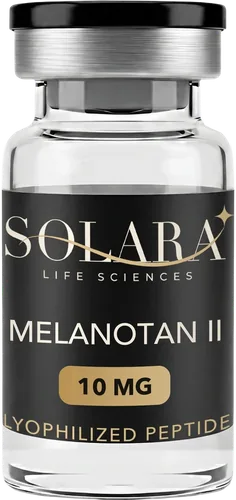
Peptide structure can be sorted three ways at once, so one molecule can sit in every class. Melanotan II is a heptapeptide (seven residues), cyclic (a lactam ring) and modified (an acetyl cap at one end, an amide at the other).
Types of peptides by length
Numeral prefixes name short chains exactly: a dipeptide has two residues, a tripeptide three, a tetrapeptide four. Counts are the sequence lengths in each compound's PubChem record; IGF-1 LR3 is counted from the literature as IGF-I (70 residues) plus a 13-residue extension.
| Compound | Residues | Name by length |
|---|---|---|
| KPV; GHK (the peptide in GHK-Cu) | 3 | tripeptide |
| Epithalon; SS-31 | 4 | tetrapeptide |
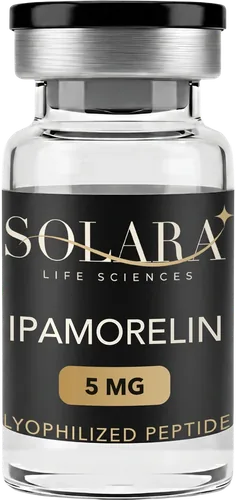
| Ipamorelin | 5 | pentapeptide |
| Selank; Semax | 7 | heptapeptide |
| DSIP | 9 | nonapeptide |
| Kisspeptin-10 | 10 | decapeptide |
| BPC-157 | 15 | oligo- or polypeptide |
| MOTS-c | 16 | oligo- or polypeptide |
| Thymosin alpha 1 | 28 | polypeptide |
| Tesamorelin | 44 | polypeptide |
| IGF-1 LR3 | 83 | protein |
Peptide vs polypeptide vs protein
The line between these words is a convention, and sources differ. The IUPAC-IUB recommendations allow oligopeptide for fewer than about 10 to 20 residues and polypeptide for more; polypeptides of specific sequence beyond about 50 residues are usually called proteins, though authors differ greatly. What are peptides covers the basic definition.
In the table, BPC-157 and MOTS-c sit in the 10-to-20 band where the cut is not fixed. Thymosin alpha 1 and tesamorelin are polypeptides under the 50-residue mark. IGF-1 LR3 is longer than 50 residues, and its NMR solution structure shows the three alpha-helices of IGF-I, with the 13-residue extension largely flexible.
Linear and cyclic peptides
A linear peptide is an open chain. A cyclic peptide has a bond closing the chain between two of its parts: head to tail, side chain to side chain through an amide (lactam) bond, or a disulfide bridge between two cysteines.
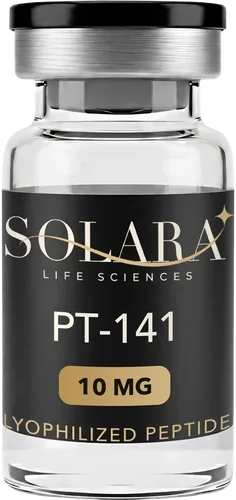
Melanotan II and bremelanotide (PT-141) are cyclic by the lactam route. Both read Ac-Nle-cyclo[Asp-His-D-Phe-Arg-Trp-Lys], the ring closing between the Asp and Lys side chains (Nle is norleucine). They differ only at the C-terminus: Melanotan II ends in an amide (-NH2), bremelanotide in a free acid (-OH), the whole difference between their PubChem formulas, C50H69N15O9 and C50H68N14O10, so they are two distinct compounds.
How peptides are modified
A modification is a chemical change to the plain chain of residues. How research peptides are named lists the shorthand markers.
- End modifications. Thymosin alpha 1 is acetylated at the N-terminus (Ac-SDAAVDTSSEITTKDLKEKKEVVEEAEN). Kisspeptin-10, SS-31 and ipamorelin end in an amide (-NH2) in place of the acid.
- Non-standard and D-residues. Ipamorelin is Aib-His-D-2-Nal-D-Phe-Lys-NH2: Aib is 2-aminoisobutyric acid, D-2-Nal is D-2-naphthylalanine, and D-Phe is the mirror-image form of phenylalanine. SS-31 is D-Arg-Dmt-Lys-Phe-NH2, with 2,6-dimethyltyrosine (Dmt).
- Lipidation. A fatty acid chain joined to a side chain through a linker. In their PubChem records, semaglutide carries an 18-carbon diacid and tirzepatide a 20-carbon one, each on a lysine through gamma-glutamic acid and two short ether spacers.
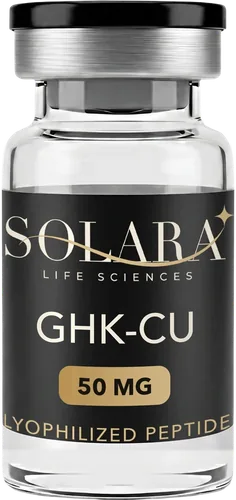
- Metal complexes. GHK-Cu is the copper(II) complex of Gly-His-Lys; the copper is held by coordination bonds, outside the chain.
Where Solara's labels stand
What this does not establish
- These classes describe structure only; nothing here describes what any compound does.
- The oligopeptide, polypeptide and protein boundaries are conventions, so one chain can be named differently by different sources.
Questions
What is the difference between a peptide and a polypeptide?
What is a cyclic peptide?
What is a lipidated peptide?
References
- IUPAC-IUB Joint Commission on Biochemical Nomenclature. Nomenclature and symbolism for amino acids and peptides. Recommendations 1983. Eur J Biochem, 1984.
- White CJ, Yudin AK. Contemporary strategies for peptide macrocyclization. Nat Chem, 2011.
- Laajoki LG et al. Solution structure and backbone dynamics of long-[Arg(3)]insulin-like growth factor-I. J Biol Chem, 2000.
Every compound on this site is supplied as a lyophilized powder for laboratory research use only. Nothing in this article describes an effect on a person or is a claim about any product.