How a peptide sequence is written
A peptide sequence is written from the N-terminus to the C-terminus, one symbol per residue, in the three-letter code (Gly-His-Lys) or the one-letter code (GHK), with prefixes and suffixes such as Ac- and -NH2 marking modified ends. An amino acid sequence is a specification: changing one symbol, or reversing the order, names a different molecule.
A residue is an amino acid as it sits inside a chain. A sequence lists residues in order, using symbols fixed by IUPAC-IUB recommendations, so that one text means one chain.
The three-letter and one-letter codes
The three-letter amino acid code gives each of the 20 standard amino acids a capital and two lower-case letters (Gln, not GLN), joined by hyphens that stand for peptide bonds. The one-letter amino acid code uses one capital and no separators. IUPAC-IUB recommends it for comparing long sequences in tables, and the three-letter form for running text.
| Amino acid | Three-letter | One-letter |
|---|---|---|
| Alanine | Ala | A |
| Arginine | Arg | R |
| Asparagine | Asn | N |
| Aspartic acid | Asp | D |
| Cysteine | Cys | C |
| Glutamic acid | Glu | E |
| Glutamine | Gln | Q |
| Glycine | Gly | G |
| Histidine | His | H |
| Isoleucine | Ile | I |
| Leucine | Leu | L |
| Lysine | Lys | K |
| Methionine | Met | M |
| Phenylalanine | Phe | F |
| Proline | Pro | P |
| Serine | Ser | S |
| Threonine | Thr | T |
| Tryptophan | Trp | W |
| Tyrosine | Tyr | Y |
| Valine | Val | V |
Nine one-letter codes are not the initial of the amino acid's name: R (arginine), N (asparagine), D (aspartic acid), Q (glutamine), E (glutamic acid), K (lysine), F (phenylalanine), W (tryptophan) and Y (tyrosine). Q and E, like N and D, differ in the side chain only by an amide against a carboxylic acid.
Which way a peptide sequence runs
A peptide has two different ends, the N-terminus and the C-terminus. The N-terminus is the amino end and is written first, on the left; the C-terminus is the carboxyl end and is written last, on the right. Residues are numbered from the N-terminus.
The direction belongs to the molecule, since each peptide bond joins the carboxyl of one residue to the amino of the next. GHK (Gly-His-Lys) and KHG (Lys-His-Gly) share a composition and a mass, yet are two different peptides.
Writing modified ends and residues
| Written | States |
|---|---|
| Ac- | Acetyl group on the N-terminal amino group |
| -NH2 | C-terminal amide, in place of the free carboxyl group |
| H- and -OH | Free ends written out; often omitted |
| D-Phe | D-configuration residue; unmarked chiral residues are L |
| Aib, Nle | Non-standard residues: 2-aminoisobutyric acid, norleucine |
| cyclo[...] | Residues in brackets joined into a ring; in the Melanotan II record the ring closes between the Asp and Lys side chains, not end to end |
PubChem's synonym for Melanotan II is Ac-Nle-Cyclo[Asp-His-D-Phe-Arg-Trp-Lys]-NH2 (CID 92432) and ipamorelin as Aib-His-D-2-Nal-D-Phe-Lys-NH2 (CID 9831659). A disulfide bridge between two cysteines is drawn as a line in the IUPAC-IUB system, so in plain text it is usually stated separately, by position.
Catalogue names written out
Each three-letter sequence below is the one PubChem lists for the record cited on the product page; GHK-Cu's page cites the copper complex (CID 71587328), so the GHK row uses the free tripeptide's record (CID 73587); the one-letter forms are read off with the amino acid table. The copper(II) in GHK-Cu is a bound ion, not a residue, so it is absent from the sequence.
| Name | Three-letter code | One-letter code | PubChem CID |
|---|---|---|---|
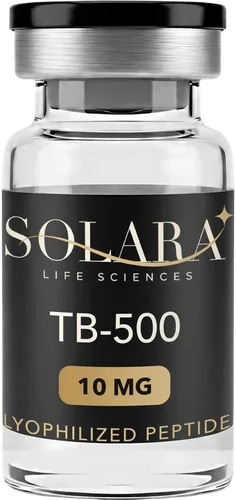
| TB-500 | Ac-Leu-Lys-Lys-Thr-Glu-Thr-Gln-OH | Ac-LKKTETQ | 62707662 |
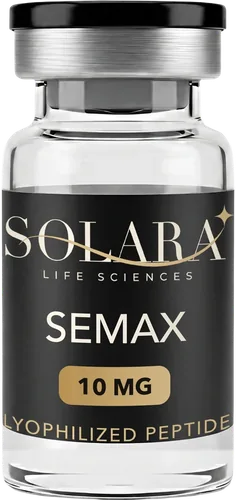
| Semax | Met-Glu-His-Phe-Pro-Gly-Pro | MEHFPGP | 9811102 |
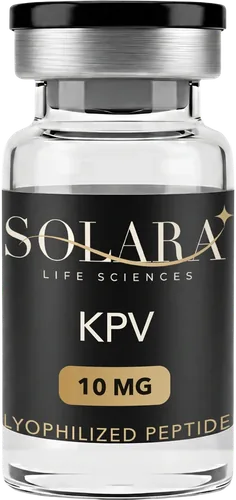
| KPV | Lys-Pro-Val | KPV | 125672 |
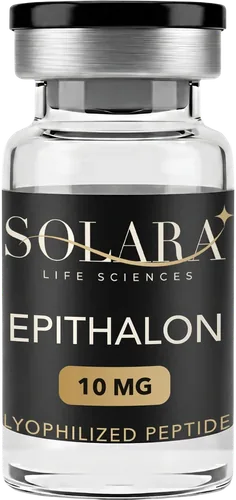
| Epithalon | Ala-Glu-Asp-Gly | AEDG | 219042 |
| GHK | Gly-His-Lys | GHK | 73587 |
Solara's labels do not print the sequence, and Solara does not publish lot documentation that states it. Each sequence in the table is the PubChem record's, not a measurement of any vial.
What this does not establish
- A written sequence fixes residue order only; it does not state purity, salt form, quantity, three-dimensional structure or which of two similarly named molecules a vial holds.
- Conventions differ at the edges: IUPAC-IUB 1983 keeps cyclo(...) for rings closed only by ordinary peptide bonds and draws a side-chain ring with lines, while the PubChem synonym for Melanotan II writes its side-chain ring as Cyclo[...]; the 1983 text also prefers Ahx to Nle for 2-aminohexanoic acid.
- The amino acid table covers the 20 standard amino acids only; selenocysteine (Sec, U), the ambiguity codes B, Z and X, and modified residues are not tabulated.
Questions
Which end of a peptide sequence is written first?
What is the one-letter code for glutamine?
What does Ac- mean at the start of a peptide sequence?
References
- IUPAC-IUB Joint Commission on Biochemical Nomenclature (JCBN). Nomenclature and symbolism for amino acids and peptides. Recommendations 1983. Eur J Biochem, 1984.
- IUPAC-IUB Commission on Biochemical Nomenclature. A one-letter notation for amino acid sequences. Tentative rules. J Biol Chem, 1968.
- Kim S et al. PubChem 2023 update. Nucleic Acids Res, 2023.
Every compound on this site is supplied as a lyophilized powder for laboratory research use only. Nothing in this article describes an effect on a person or is a claim about any product.