D- and L-amino acids in synthetic peptides
D-amino acids are the mirror-image forms of the L-amino acids from which the ribosome builds proteins; every standard amino acid except glycine is chiral and exists in both forms. A synthetic peptide can carry a D-residue by design, written D-Phe, or by accident, through racemization during synthesis.
The alpha carbon of an amino acid carries an amino group, a carboxyl group, a hydrogen and a side chain. When all four differ, the carbon is a stereocentre and the molecule exists as two non-superimposable mirror images, the L and D forms; this property is chirality. Glycine, whose side chain is a second hydrogen, is the one standard amino acid without it.
The D and L labels relate each amino acid to glyceraldehyde by the Fischer convention; they do not map one-to-one onto the R and S labels of the Cahn-Ingold-Prelog system. L-cysteine is R, because its CH2SH group outranks the carboxyl group (sulfur outranks oxygen), while every other chiral standard L-amino acid is S. Isoleucine and threonine have a second stereocentre in the side chain, so each has four stereoisomers.
D-amino acids by design
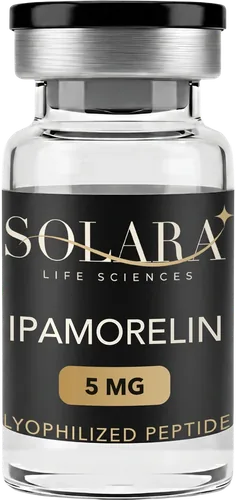
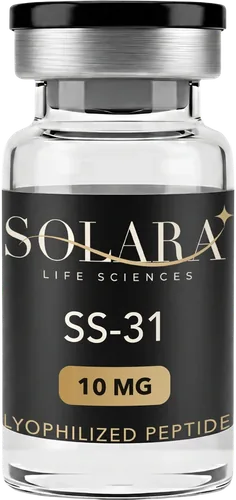
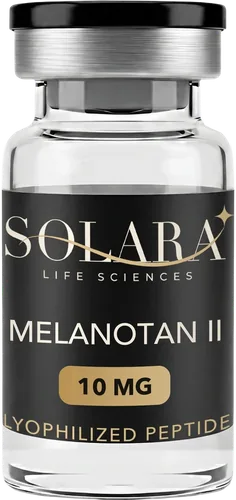
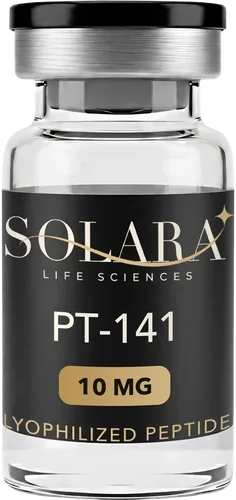
A residue is read as L unless it carries a D prefix, so D-Phe is D-phenylalanine. Four catalogue compounds are written with D-residues in their PubChem records; the sequences below are reference data for each compound, not measurements of any Solara lot.
| Compound | Sequence as PubChem records it | D-residues |
|---|---|---|
| Ipamorelin | Aib-His-D-2-Nal-D-Phe-Lys-NH2 | D-2-Nal, D-Phe |
| SS-31 | D-Arg-Dmt-Lys-Phe-NH2 | D-Arg |
| Melanotan II | Ac-Nle-cyclo[Asp-His-D-Phe-Arg-Trp-Lys]-NH2 | D-Phe |
| PT-141 | Ac-Nle-cyclo[Asp-His-D-Phe-Arg-Trp-Lys]-OH | D-Phe |
PubChem gives no short form for PT-141 (CID 9941379); its row is transcribed from the record's systematic name, in which the ring is a lactam between Asp and Lys.
Aib is 2-methylalanine, 2-Nal 3-(2-naphthyl)alanine, Dmt 2,6-dimethyltyrosine and Nle norleucine. Aib has two methyl groups on its alpha carbon, so like glycine it is achiral: its mirror image is the same molecule.
Racemization during synthesis
Racemization converts one configuration at an alpha carbon into a mixture of both. Within a peptide, where every other stereocentre is unchanged, the product is a diastereomer of the target (the cited review calls this epimerization): the same formula and mass, but a different compound.
It happens mainly when a protected amino acid is activated for coupling: activation makes the alpha hydrogen acidic, and a base in the coupling mixture can remove it, directly or via a cyclic oxazolone. The planar intermediate takes a proton back from either face, so the residue couples as a mixture of L and D. Cysteine and histidine are among the residues most prone to it.
Acid hydrolysis for amino acid analysis, commonly 6 N HCl at 110 °C, can also invert residues, so methods correct for it.
How chiral purity is measured
Chiral purity is the share of each amino acid in its intended configuration. A single inverted residue gives a diastereomer with the same mass as the target, so intact mass spectrometry cannot see it. Reverse-phase HPLC sometimes separates diastereomers, but not reliably.
The dependable route is hydrolysis, then chiral analysis of the free amino acids. Marfey's reagent, which carries an L-alanine amide group, derivatizes the amino acids so that D and L forms become diastereomers, which an ordinary reverse-phase column separates; gas chromatography on a chiral column is one alternative. Hydrolysis in deuterated acid (DCl in D2O) tags any residue that inverts during hydrolysis with deuterium, which a mass detector can tell from a D-residue already present. Either route gives a D:L ratio per kind of amino acid, not the position of an inverted residue.
What this does not establish
- No statement is made about any biological property of D- or L-forms of any amino acid or peptide.
- The sequences are PubChem records for each compound; they do not show what any lot contains.
- No racemization rate is given; the extent depends on the residue, the reagents and the conditions.
Questions
What is the difference between D and L amino acids?
Is glycine chiral?
Can mass spectrometry detect a D-amino acid?
References
- IUPAC-IUB Joint Commission on Biochemical Nomenclature. Nomenclature and symbolism for amino acids and peptides. Recommendations 1983. Eur J Biochem, 1984.
- Bhushan R, Bruckner H. Marfey's reagent for chiral amino acid analysis: a review. Amino Acids, 2004.
- Duengo S et al. Epimerisation in Peptide Synthesis. Molecules, 2023.
- Miyamoto T et al. Generation of enantiomeric amino acids during acid hydrolysis of peptides detected by the liquid chromatography/tandem mass spectroscopy. Chem Biodivers, 2010.
Every compound on this site is supplied as a lyophilized powder for laboratory research use only. Nothing in this article describes an effect on a person or is a claim about any product.