Copper peptides: the chemistry of GHK-Cu
A copper peptide is a peptide that holds a copper ion by coordinate bonds, and GHK-Cu is the copper(II) complex of the tripeptide glycyl-L-histidyl-L-lysine (GHK). Nitrogen atoms of the peptide bind the Cu(II) ion, and the d-d electronic transitions of that bound ion are what make the material blue.
GHK is a three-residue peptide: glycine at the amino end, L-histidine in the middle and L-lysine at the carboxyl end (Gly-His-Lys). GHK occurs naturally in human serum, where it is one of the peptides that bind copper(II) tightly (Trapaidze et al., 2012).
PubChem lists the complex as prezatide copper and the peptide alone as glycyl-L-histidyl-L-lysine. The values below are PubChem reference values for the compounds, not measurements of any Solara lot.
| Entry | GHK (peptide) | GHK-Cu (complex) |
|---|---|---|
| PubChem CID | 73587 | 71587328 |
| CAS number | 49557-75-7 | 89030-95-5 |
| Molecular formula | C14H24N6O4 | C14H23CuN6O4+ |
| Average molecular weight (g/mol) | 340.38 | 402.92 |
The +1 in the complex formula comes from PubChem drawing Cu2+ beside a peptide that has lost one proton (at the carboxyl group). The record states composition and charge; it does not draw the bonds described next.
How a copper peptide binds copper
In the 1:1 complex, Cu(II) sits in a plane of four donor positions. Three are nitrogen atoms of the peptide: the amino nitrogen of glycine, the deprotonated amide nitrogen of the glycine-histidine peptide bond, and a nitrogen of the histidine imidazole ring. The three bonds close two fused chelate rings (Ufnalska et al., 2021).
The fourth position is labile. In the crystal, where the complex forms dimers, a carboxylate oxygen fills it. In solution the complex is a monomer (Hureau et al., 2011), and water holds the fourth position until a ligand such as imidazole displaces it (Ufnalska et al., 2021). A species with two peptides per copper has been invoked to explain fast copper exchange (Hureau et al., 2011), and which species dominates depends on the pH and on the copper-to-peptide ratio; at pH 7.4, GHK binds Cu(II) predominantly one to one (Trapaidze et al., 2012).
Why GHK-Cu is blue
A Cu(II) ion has nine d electrons, and the surrounding ligands split the energies of its d orbitals. Moving an electron between the split levels absorbs light of a matching wavelength: a d-d transition. For Cu(II)-GHK in aqueous buffer at pH 7.4 the band sits at 606 nm, in the orange (Ufnalska et al., 2021). With orange removed from the transmitted light, what remains reads as blue.
The ligand set moves the band: saturating the fourth position with imidazole shifts it to 565 nm. Free GHK has no absorption in the visible range, so the peptide alone is colourless.
Handling a copper complex
Copper is redox-active: Cu(II) can be reduced to Cu(I). In a cyclic voltammetry study, Cu(II)-GHK was inert at moderate potentials and was reduced to Cu(I) at about −0.62 V versus AgCl/Ag, after which the copper ion was released (Hureau et al., 2011). Separately, Solara's storage guidance describes copper complexes as photosensitive.
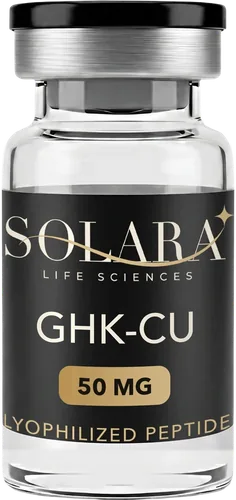
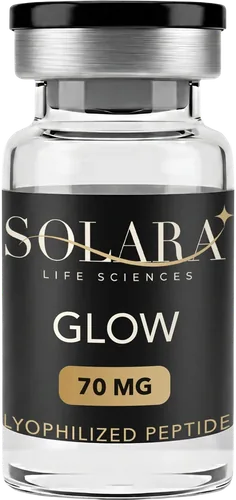
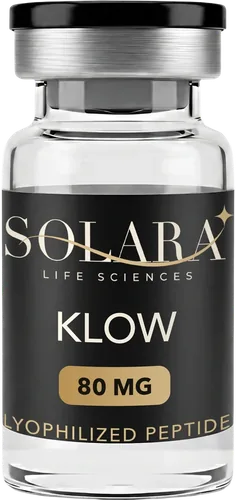
GHK-Cu is also a component of the GLOW and KLOW preparations, each listed with GHK-Cu 50 mg, and the photosensitivity guidance covers them too. Whether the other peptides in a blend change the copper species has not been published.
Where Solara's documentation stands
Solara does not publish copper content or a copper-to-peptide ratio for any lot, so no such figure is stated for GHK-Cu, GLOW or KLOW.
What this does not establish
- Nothing here describes any biological property of GHK or GHK-Cu; the article covers composition, bonding and colour only.
- The PubChem values describe the compounds, not a lot, and do not show the counter-ion, water content or copper-to-peptide ratio of any particular powder.
- Crystal and solution structures were measured under stated conditions (the solid state, or aqueous buffer near pH 7.4); the species present in another medium or at another ratio may differ.
Questions
What is GHK-Cu?
Why is GHK-Cu blue?
What is the difference between GHK and GHK-Cu?
References
- Hureau C et al. X-ray and solution structures of Cu(II) GHK and Cu(II) DAHK complexes: influence on their redox properties. Chemistry, 2011.
- Trapaidze A, Hureau C, Bal W, Winterhalter M, Faller P. Thermodynamic study of Cu2+ binding to the DAHK and GHK peptides by isothermal titration calorimetry (ITC) with the weaker competitor glycine. J Biol Inorg Chem, 2012.
- Ufnalska I et al. Intermediate Cu(II)-Thiolate Species in the Reduction of Cu(II)GHK by Glutathione: A Handy Chelate for Biological Cu(II) Reduction. Inorg Chem, 2021.
- Prezatide copper (compound record, CID 71587328). PubChem, National Center for Biotechnology Information, accessed 2026-10-19.
Every compound on this site is supplied as a lyophilized powder for laboratory research use only. Nothing in this article describes an effect on a person or is a claim about any product.