How synthetic peptides are made
Most research peptides of up to about 50 residues are made by solid-phase peptide synthesis: amino acids are added one at a time to a chain anchored on a resin bead, the finished chain is cleaved off, purified by preparative HPLC and freeze-dried.
The method dates to 1963, when R. B. Merrifield built a peptide on an insoluble polymer support so that excess reagents could be filtered away instead of separated after every step. The common modern form is Fmoc/tBu chemistry: each incoming amino acid carries a base-labile Fmoc group, and reactive side chains carry acid-labile, mostly tert-butyl, protecting groups.
The repeated coupling steps
Each residue is added by the same four operations. Base, typically piperidine in dimethylformamide, removes the Fmoc group and exposes the terminal amino group. The next Fmoc-protected amino acid is activated with a coupling reagent and added in excess to drive the coupling towards completion. The resin is then washed. Deprotection, activation, coupling and washing repeat once per residue, from the C-terminal end to the N-terminal end.
Cleavage and work-up
A trifluoroacetic acid (TFA) cocktail releases the chain from the resin and strips the side-chain protecting groups in one step. That generates reactive carbocations, so the cocktail includes scavengers, such as water, triisopropylsilane or a thiol, to trap them. The solution is added to cold diethyl ether, and the peptide precipitates. Because TFA is a strong acid, basic groups on the crude peptide are left as trifluoroacetate salts, which is why the crude product is a TFA salt.
Purification and freeze-drying
The crude is a mixture of the target chain and closely related by-products. Preparative reverse-phase HPLC, typically on C18 silica with a water and acetonitrile gradient, separates them by hydrophobicity. Fractions are checked by analytical HPLC and mass spectrometry, and those that meet the cut-off are pooled, frozen and lyophilized: the solvents leave by sublimation and a dry powder remains. Preparative gradients usually carry 0.1% TFA as well, so the purified powder, not only the crude, is usually a trifluoroacetate salt unless it is exchanged.
Why crude purity falls with chain length
No coupling is perfectly complete. If each runs at a yield of 0.99, a chain of n residues needs n − 1 couplings and the crude holds 0.99^(n − 1) of full-length product. For 39 residues that is 0.99^38, roughly 68%; the rest is truncated and deletion sequences. Other errors accumulate the same way: incomplete Fmoc removal, aspartimide formation at aspartic acid, worst in Asp-Gly sequences, and racemization of residues such as cysteine and histidine.
| Catalogue compound | Residues | Full-length fraction in crude |
|---|---|---|
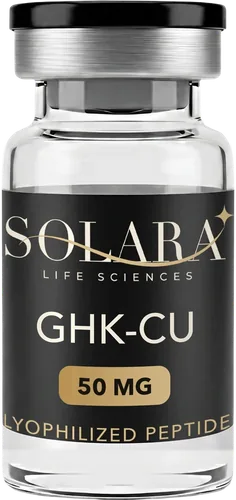
| GHK-Cu | 3 | 0.98 |
| KPV | 3 | 0.98 |
| BPC-157 | 15 | 0.87 |
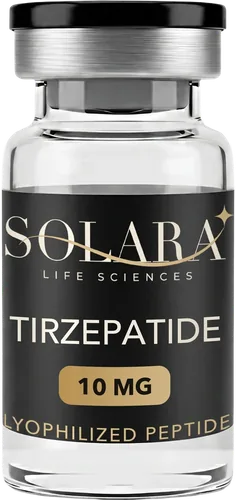
| Tirzepatide | 39 | 0.68 |
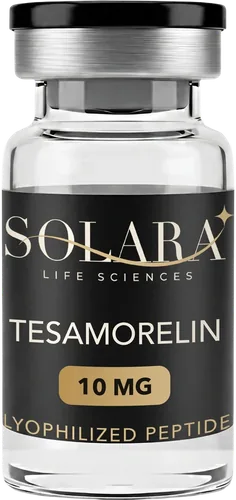
| Tesamorelin | 44 | 0.65 |
A tripeptide such as GHK needs two couplings and is straightforward. A 44-residue chain such as tesamorelin needs forty-three, and its purification must separate far more near-identical by-products.
What the catalogue describes
Solara does not publish the synthesis route, the crude purity or the manufacturer of a lot; the catalogue describes the supplied material only: a lyophilized powder labelled with the compound name, the quantity in milligrams, the form, an expiry date, and "for research use only".
What this does not establish
- A high final purity says nothing about yield, route or how much of the crude was discarded.
- This article describes chemistry only and makes no statement about any biological property.
- Matching a natural sequence is a statement about covalent structure only; several catalogue compounds, tesamorelin and tirzepatide among them, carry modifications with no natural counterpart.
Questions
Why are long peptides more costly to produce than short ones?
What does solid-phase mean?
Can a synthetic peptide have the same covalent structure as a peptide isolated from nature?
References
- Behrendt R et al. Advances in Fmoc solid-phase peptide synthesis. Journal of Peptide Science, 2016.
- Isidro-Llobet A et al. Amino acid-protecting groups. Chemical Reviews, 2009.
- Amblard M et al. Methods and protocols of modern solid phase peptide synthesis. Molecular Biotechnology, 2006.
Every compound on this site is supplied as a lyophilized powder for laboratory research use only. Nothing in this article describes an effect on a person or is a claim about any product.