Light and peptides
Light degrades a peptide when something in it absorbs the light, chiefly the aromatic side chains of tryptophan and tyrosine, disulfide bonds, and metal centres such as the copper in GHK-Cu; the excited state then oxidizes residues such as methionine, histidine and tryptophan, often through singlet oxygen. A dry lyophilized solid is generally more resistant than a solution but not immune, which is why the powder is kept protected from light.
Light alters a peptide only after something in it absorbs the light. The peptide bond itself absorbs only below about 220 nm, outside what room lighting emits. Above that, absorption comes from side chains: the aromatic rings of tryptophan (near 280 nm) and tyrosine (near 275 nm), and, more weakly, disulfide bonds between cysteines.
Many of the damaging reactions are indirect. An excited chromophore passes its energy to oxygen, forming singlet oxygen, which then oxidizes a neighbouring residue. The documented products include:
- Tryptophan to N-formylkynurenine and kynurenine, the latter yellow.
- Methionine to methionine sulfoxide.
- Histidine, whose imidazole ring is oxidized.
- Cystine, whose disulfide bond can cleave.
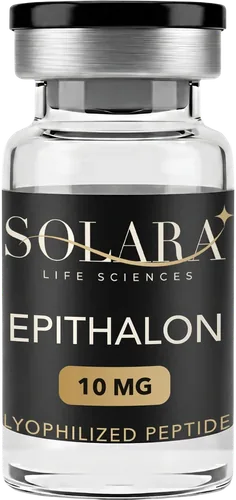
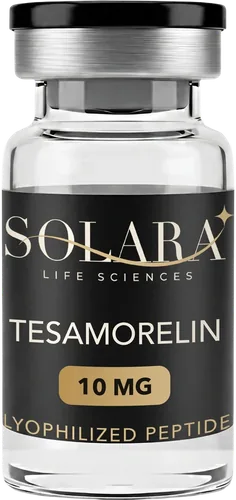
Sequence therefore determines which of these routes are available. Epithalon (Ala-Glu-Asp-Gly) has no aromatic, sulfur-containing or histidine residue and absorbs very little above 220 nm. Tesamorelin carries methionine and tyrosine, so it has both an absorbing residue and an oxidizable one. These are statements about structure, not measurements of any lot.
Why copper complexes are a special case
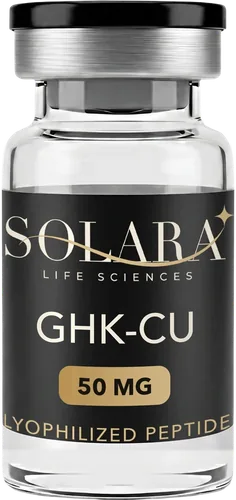
Copper(II) in GHK-Cu absorbs in the visible range, which is what gives the complex its blue colour. Copper also catalyzes oxidation, so the complex holds both a light-absorbing centre and a metal that can drive oxidative chemistry. Solara's handling guidance records that copper complexes are photosensitive; no photostability data for GHK-Cu are published.
How photostability is tested
The harmonized reference method is ICH Q1B. Confirmatory exposure is an overall illumination of not less than 1.2 million lux hours and an integrated near-ultraviolet energy of not less than 200 watt hours per square metre. A dark control held alongside separates change caused by heat from change caused by light. Exposed and control material are then compared for appearance, assay and degradation products, which for peptides usually means HPLC.
Solid versus solution, and shielding
A lyophilized cake is generally more resistant than a solution of the same peptide. Molecular mobility in the dry solid is low and there is no dissolved oxygen, and both slow photochemistry. Resistant is not immune: absorption still occurs, and residual oxygen in the vial headspace remains a variable.
Shielding works on the light, not the chemistry. Amber glass cuts transmission below roughly 450 nm, which covers the near-ultraviolet and blue range, and an opaque carton removes the remainder.
Solara's site guidance is to store the lyophilized powder at −20 °C, protected from light. Solara has not published photostability data for any lot, so its light-protection guidance is general handling practice, not a result measured on Solara's material.
What failure looks like
What this does not establish
- Sensitivity to light is a property of a molecule's chemistry. This article makes no statement about any biological property.
- A peptide that is photostable is not therefore stable to heat or moisture.
- The extent of degradation depends on the amount of light, its wavelength and the matrix, so no single figure applies to all peptides.
Questions
Why is GHK-Cu blue?
Does a lyophilized powder still degrade in light?
What does ICH Q1B test?
References
- Kerwin BA, Remmele RL Jr. Protect from light: photodegradation and protein biologics. Journal of Pharmaceutical Sciences, 2007.
- Pattison DI, Rahmanto AS, Davies MJ. Photo-oxidation of proteins. Photochemical & Photobiological Sciences, 2012.
- Davies MJ. Singlet oxygen-mediated damage to proteins and its consequences. Biochemical and Biophysical Research Communications, 2003.
- Q1B Stability Testing: Photostability Testing of New Drug Substances and Products. International Council for Harmonisation (ICH), 1996.
Every compound on this site is supplied as a lyophilized powder for laboratory research use only. Nothing in this article describes an effect on a person or is a claim about any product.